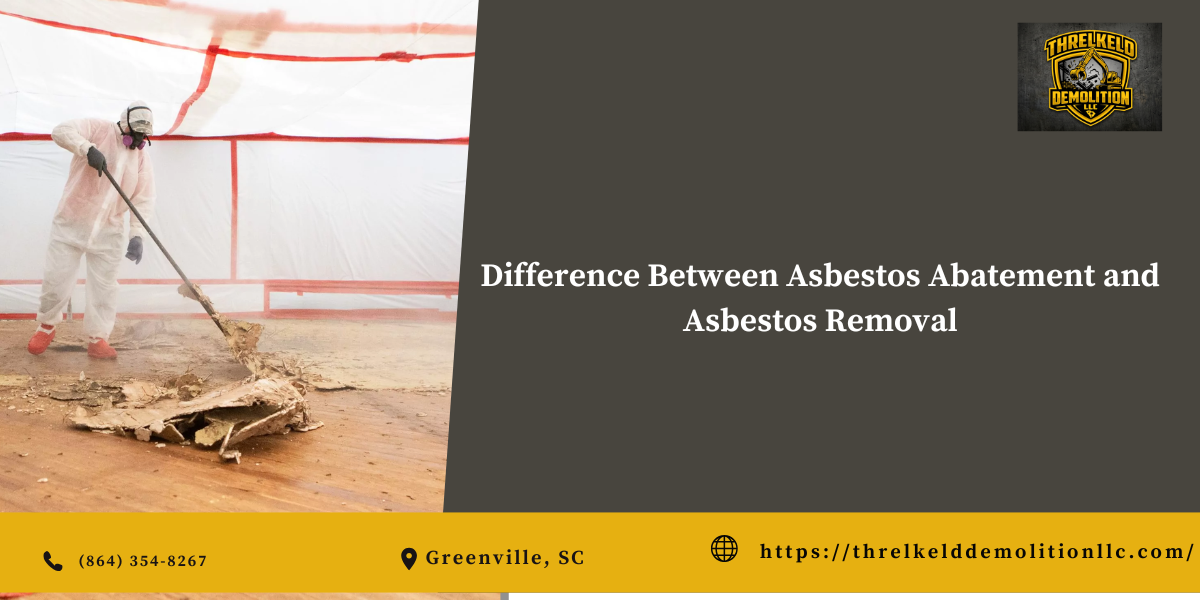
The most important aspect of dealing with asbestos in your home or building is hiring a competent professional, but when choosing someone and understanding what they will do to protect your family from toxic microscopic fibers, learning the difference between asbestos abatement and removal is critical.
Asbestos removal refers simply to detaching the material, whereas asbestos abatement describes a broader array of risk management strategies involving assessment, containment, encapsulation, repairs, HEPA air filtration, and certified testing to assure regulatory compliance.
What’s the Real Difference Between Asbestos Abatement and Asbestos Removal?
If they seem synonymous to you, do not feel bad, as that is the experience for many property owners, but the contrast is very important when hiring someone and receiving estimates, as it has enormous implications on project scope and cost.
What Is Asbestos Removal?
Simply put, asbestos removal describes solely the act of physically removing asbestos from the property and is essentially a more specific form of abatement.
- Scope of Operation: The actual work includes scraping drywall off popcorn ceilings, taking off pipe insulation, separating floor tiles from the subfloor, and detaching transite siding.
- Part of a Wider Solution: Asbestos removal is just one step toward total hazard management. It alone is ineffective, potentially dangerous, and unlawful if it doesn’t follow stringent guidelines.
What Is Asbestos Abatement in Anderson, SC?
Asbestos abatement is a term that encompasses every step that might be taken to deal with asbestos in a structure and can sometimes, but not always, include the asbestos removal process.
- All-inclusive procedure: Abatement can also entail examining the construction materials to test if they’re already hazardous or if they may become so and testing any samples to confirm the presence of fibers. Notification of official agencies, sealing of the structure, HEPA air filtration installation, worker decontamination chambers, disposal permits, and clearance testing to ensure inhabitants are completely safe from airborne particles are all included.
- Control Options: Since destruction is not always needed to eliminate hazard, other possible mitigation strategies may also be part of a complete asbestos abatement plan. An inspector’s assessment may report that you might not need to have materials removed and suggest they can just be encapsulated or enclosed, or that abatement requires negative pressure enclosure for the worker’s safety and your family’s protection.
Alternative Abatement Strategies (When Removing the Material Isn’t Always Necessary)
Several situations may involve sealing the material, as opposed to removing it entirely from a residence or structure, that is still legally termed as abatement.
Encapsulation: When materials are intact but still contain the fibers. Technicians spray over loose, exposed, and accessible portions. The liquid itself penetrates, encapsulates, and consolidates the harmful dust, preventing it from releasing into the atmosphere. This strategy is great for thermal pipes and plaster work around exposed surfaces.
Enclosure: This strategy involves creating a physical barrier that surrounds the materials containing asbestos, keeping the hazard locked behind it. This is an efficient method for items that remain well intact and don’t require physical removal during the renovation or repair project you are currently undertaking.
The Full Step-by-Step Asbestos Abatement Workflow
If asbestos removal is found necessary as part of an abatement program, professionals would take the following steps.
Negative Air Pressure and Containment: The job begins by isolating the whole work area of the suspected asbestos-infested room and sealing any open vents, doorways, and spaces with thick, opaque poly sheeting so nothing will be released into the air. The room’s ventilation would have a HEPA filter-equipped unit set up to establish negative pressure. Any air that leaves the room’s space and exhaust would be captured, filtered, and then released outside the structure’s footprint so no contaminated dust ever passes through the home’s air ducts or main living space.
Wet-Removal and Hazardous Waste Disposal: The physical stripping part begins as trained professionals carefully use wet tools or apply a fine mist of water, using agents called encapsulating agents or binding agents, on debris as they are dismantled so none of the airborne fibers will fly into the air and travel through the air purification unit. Then, every single particle of debris collected would be sealed in heavy-duty poly bags and loaded into a special truck and transported to a certified hazardous waste landfill, with a manifest that follows the material every step of the way from the structure until its final resting place.
Hire A Professional: There Are Three Key Reasons Why:
Asbestos removal is a critical job that absolutely demands the use of specialized equipment and knowledge to ensure safety, which is only possible with the certification and training offered to certain professional asbestos abatement companies.
- They are Certified, Licensed & Insured: The technicians will work within strict laws and codes established by OSHA (Occupational Safety and Health Administration) and EPA (Environmental Protection Agency) to protect you, their own workers, and those in your property from the dust, fines, and possible litigation.
- They are equipped with industrial-grade HEPA filtration: It will include negative air machines that purify the air through a special filter called a HEPA filter. Their machinery effectively removes not just visibly dirty particulates but also microscopic fragments from the construction material that you might never know are there, then dispels the purified air.
- They Use Third-Party Clearance Testing: To officially qualify for the work being completed and ensure the area you are re-entering is free of any hazardous particles, the room where the asbestos removal has taken place needs to be tested by third-party environmental health specialists. The tests performed at this stage have the potential to confirm whether the work was truly completed to the professional standard you sought.
FAQs
Is asbestos abatement always the same as asbestos removal?
No. Removal is simply one physical step of stripping materials out, whereas abatement includes the total safety strategy, which may involve encapsulation or enclosure instead of removal.
When should asbestos be encapsulated rather than removed?
Asbestos should be encapsulated if the material is in good condition, undisturbed, and unlikely to be damaged, as tearing it out creates unnecessary airborne risks.
How do professionals test if asbestos removal was successful?
A certified third-party environmental hygienist conducts a clearance air test inside the contained area using phase contrast microscopy (PCM) to verify fiber counts are below safety thresholds.
Can I remove small amounts of asbestos ceiling tile myself?
It is strongly discouraged and illegal in many jurisdictions. Disturbing even small sections of friable asbestos without negative-pressure containment spreads invisible fibers throughout your home.
How long does a typical home asbestos abatement project take?
Most residential projects take between 2 and 5 days, depending on the square footage, the type of material, and the setup required for negative air containment.